Whenever artificial intelligence enters a conversation about sales and point of sale systems, the discussion tends to drift towards the large operators. Multi-station retailers, supermarket groups and franchise networks are the obvious beneficiaries, and for understandable reasons. They process enormous transaction volumes, they operate across locations with different demand profiles, and they employ people whose entire job is to interpret that data. For them, analysing consumer purchasing patterns and understanding how stock actually moves through the business is not a novelty. It is the difference between a healthy margin and a warehouse full of capital that refuses to convert into revenue.
Small and medium retailers watch this from a distance and conclude, reasonably enough, that none of it applies to them. That conclusion deserves a closer look.
The mechanism is not scale, it is the record
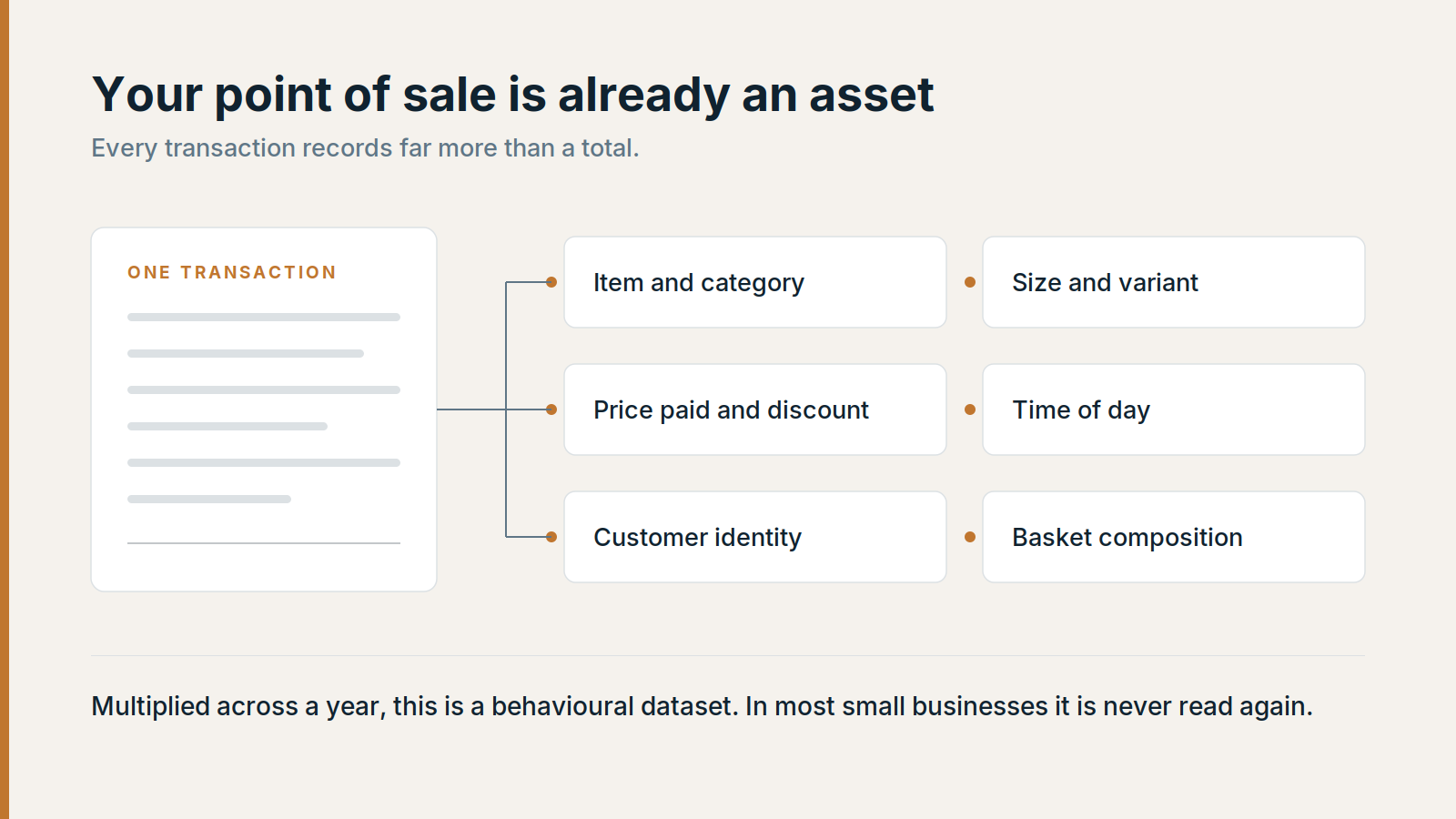
What large retailers gain from analytics is not magic conferred by size. It is the disciplined use of something every retailer already produces: a record of every transaction. Which items sold, at what price, at what time, to whom, alongside what else, and how long they sat on the shelf before moving. Scale simply makes the patterns louder and the cost of ignoring them more painful.
A clothing store with three hundred regular customers is sitting on the same raw material. Sizes, preferred colours, typical price bands, purchase frequency, seasonal behaviour and response to previous promotions are all recorded somewhere in the point of sale database. In most small businesses that information is captured faithfully and then never looked at again. It exists purely as a receipt archive rather than as an asset.
A practical example worth taking seriously
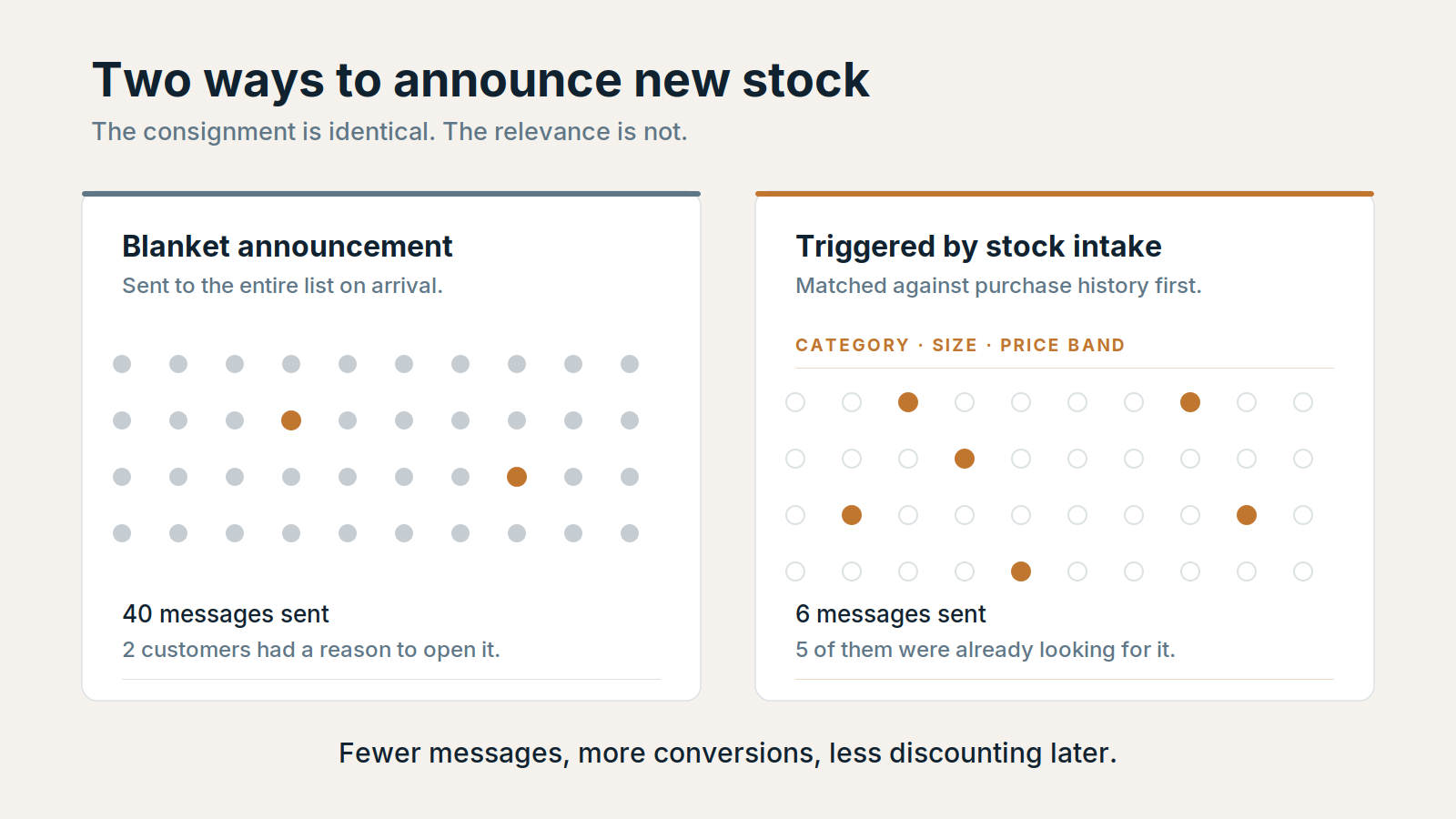
Consider that clothing business when a new consignment arrives. The conventional approach is a general announcement to the entire contact list, or a post that reaches whichever fraction of the audience the platform decides to serve it to. The results are predictable. Low engagement, a growing sense among customers that the messages are noise, and eventually a discount to clear what did not move.
Now consider the alternative. The system recognises which customers have previously purchased from that category, in those sizes, within that price band, and it sends a small number of highly relevant messages the moment the stock is received. The campaign is triggered by the inventory event itself rather than by someone remembering to write a post. The customer receives something that reads as useful rather than promotional, the conversion rate on a much smaller send exceeds the conversion rate on the blanket one, and the item sells closer to full price because it reached the right person while it was still new.
This is not sophisticated technology. It is the intelligent use of information the business already owns.
Where else the returns appear
Buying decisions are the most obvious extension. Knowing which sizes consistently sell through and which consistently end up discounted changes what a retailer orders next season, and changes it based on evidence rather than instinct. Slow movers can be identified within weeks rather than at the end of a season, which means a modest early markdown replaces a severe late one.
Customer retention is another. Systems can quietly flag regulars whose purchase pattern has broken, which gives the owner a chance to reach out while the relationship is still recoverable. Peak hour prediction improves staffing decisions in businesses where labour is one of the largest controllable costs. Basket analysis reveals which products genuinely sell together, informing both physical layout and cross-sell prompts at the counter. Anomaly detection across voids, refunds and discounts surfaces till level irregularities that manual review rarely catches.
Extending the same intelligence online
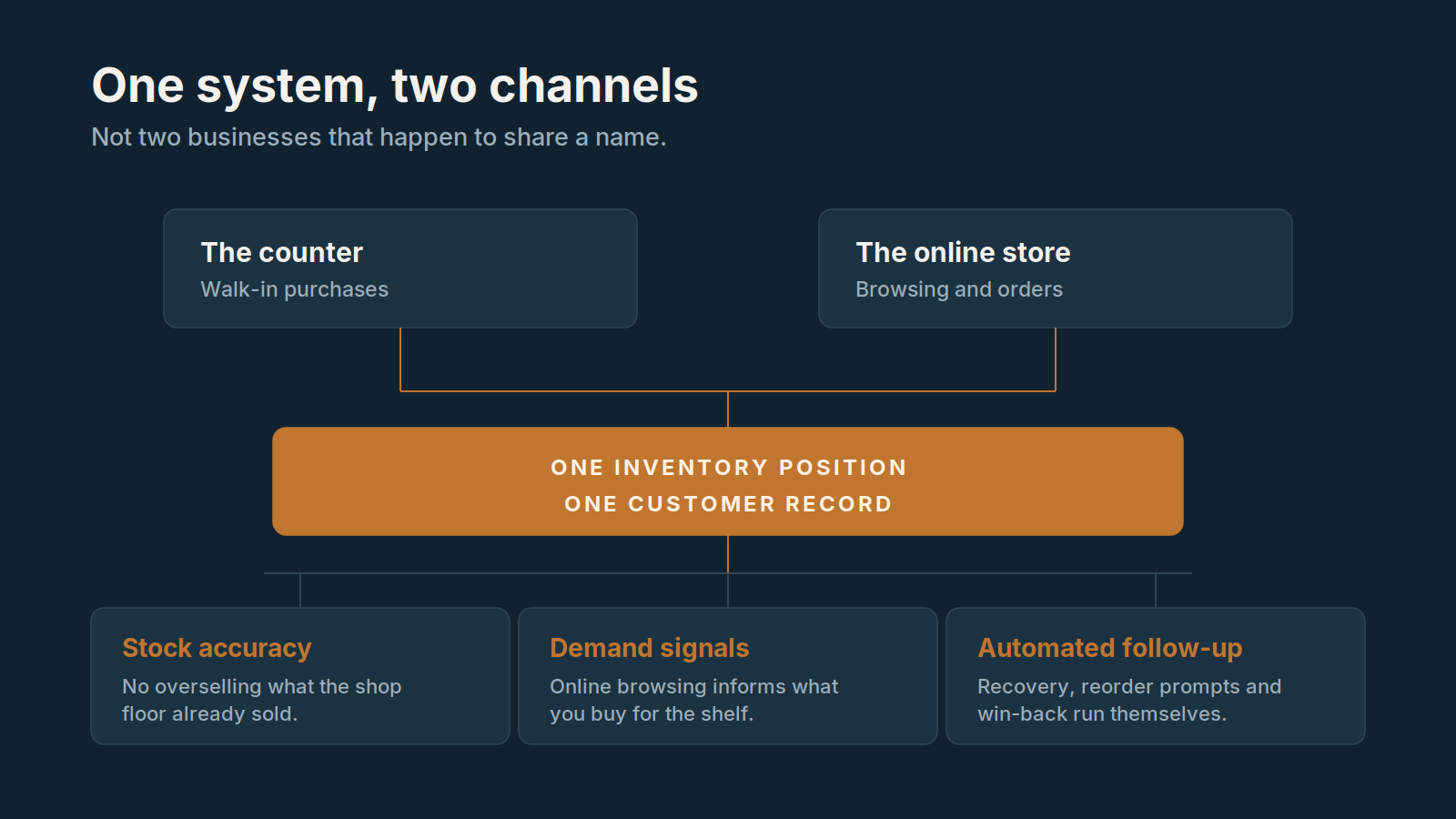
For retailers expanding into online sales, the same foundations carry over, provided the two channels share one system rather than operating as separate businesses that happen to have the same signage. A single inventory position and a single customer record are the prerequisites for everything else. Once those exist, product content generation becomes considerably less painful, and cataloguing is often the specific bottleneck that stalls a small retailer's online launch. Browsing behaviour online becomes an early indicator of demand that can inform in-store buying, abandoned baskets can be recovered automatically, and online merchandising can adapt to the individual visitor in a way a physical shelf never could.
What actually creates the edge
The advantage does not come from purchasing an AI platform. It comes from three unglamorous commitments. The first is data hygiene, because customer and product records that are inconsistent or incomplete will produce recommendations that are confidently wrong. The second is starting with a single decision the business wants to improve, whether that is reorder quantities or campaign relevance, rather than attempting a general transformation. The third is keeping human judgement in the loop, since the owner of a neighbourhood business knows things about their customers that no dataset contains.
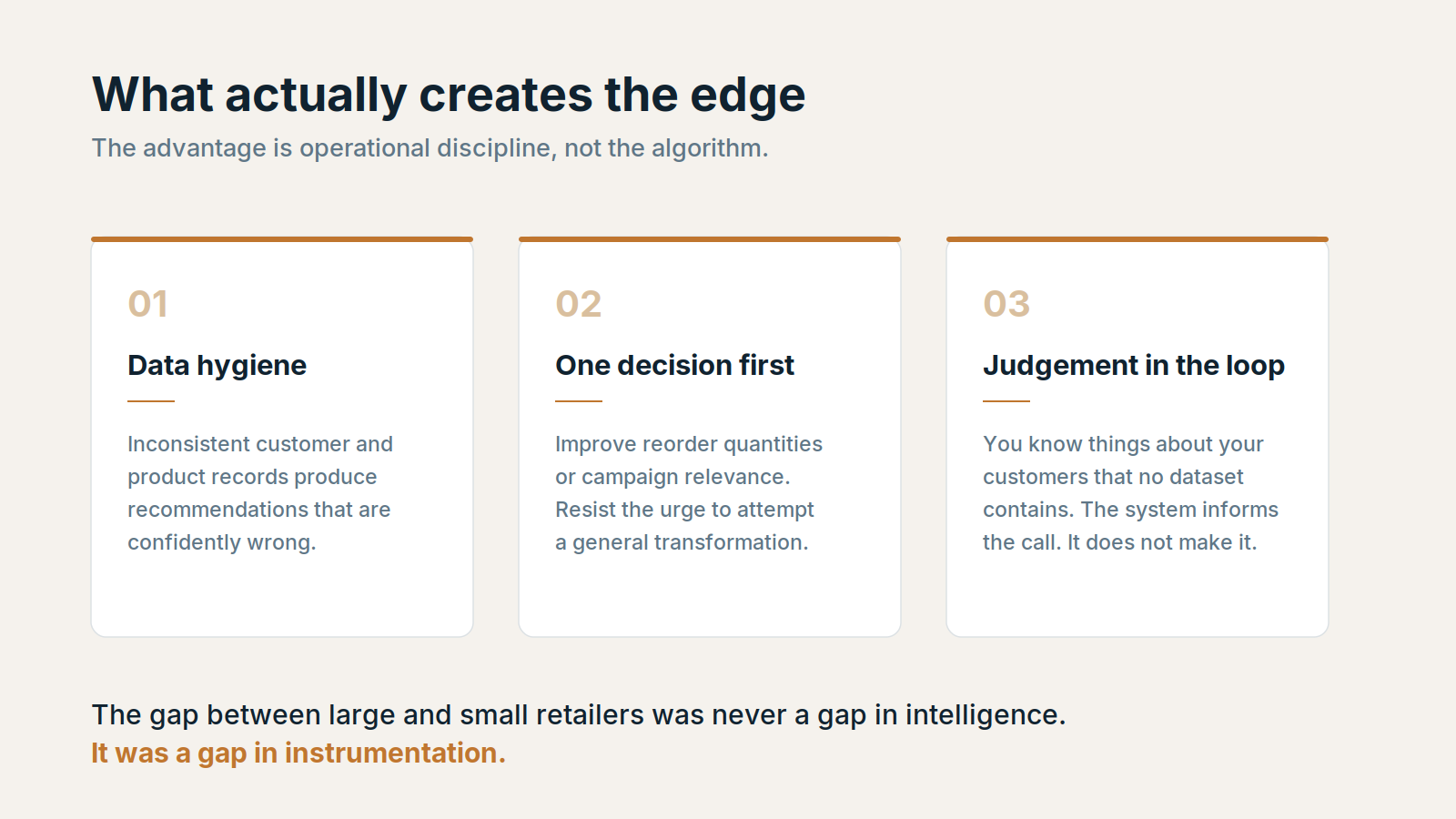
The gap between large and small retailers was never a gap in intelligence. It was a gap in instrumentation. That gap is closing, and the businesses that recognise it early will spend the next few years competing on insight rather than on price.